
To source a custom spearfishing wetsuit, decide between a one-piece and a two-piece suit, choose camouflage colorways for the water your customers dive in, pick the neoprene, lining and thickness for their water temperature, add spearfishing details such as a loading pad and knee pads, and approve everything on a physical sample. At YALISI SPORTS, a Dongguan wetsuit manufacturer established in 2015, the minimum order quantity is 100 pieces and every project follows five steps: define, develop, sample, produce and inspect.
1. One-piece or two-piece?
The first decision shapes the rest of the range:
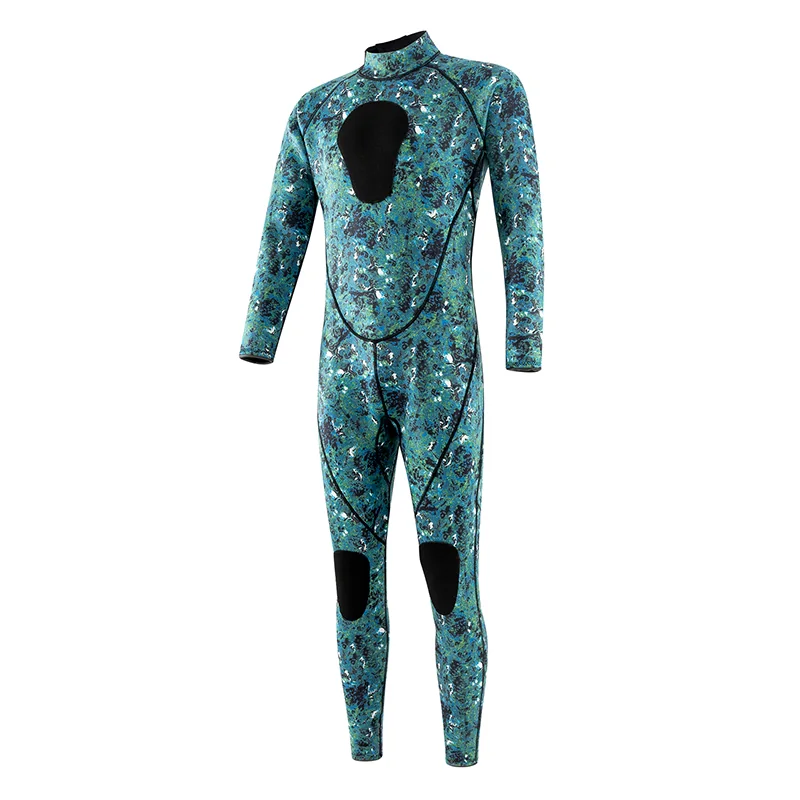
- One-piece suits usually have a back or chest zipper. They are quick to put on and are common in warmer water. Our KKQ-003 camouflage full wetsuit is a reference example: 3 mm neoprene, flatlock construction, back zip, sizes S–4XL.
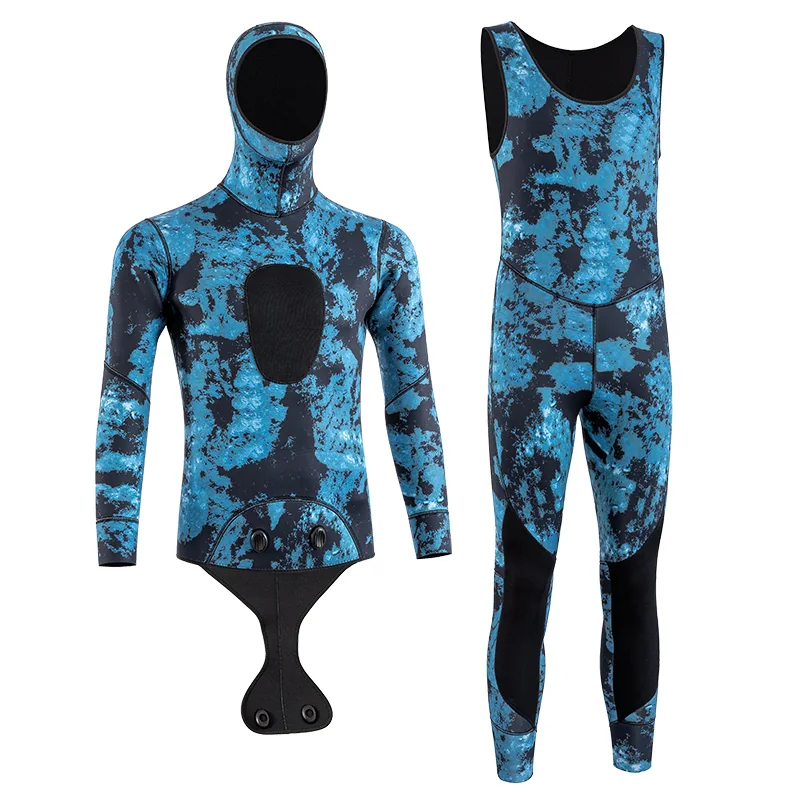
- Two-piece suits combine a hooded jacket with a long john (high-waisted trousers). The jacket overlaps the trousers, the hood is attached, and many designs have no zipper at all, which reduces the points where water can enter. Our KKQ-008 spearfishing suit follows this design in 3 mm and 5 mm, with no zipper and sizes S–4XL.
Many spearfishing brands carry both: a one-piece for warm-water customers and a two-piece for longer sessions or cooler water.
2. Choose camouflage for your customers’ water
Camouflage is the most visible design choice in a spearfishing range, and it should match where the suits will be used:
- Blue camouflage is associated with open, blue water and offshore diving.
- Green and brown camouflage is associated with reefs, kelp, rocky coastlines and greener water.
- Solid black is a neutral option for buyers who want a simple, classic suit.
Our published spearfishing examples include blue camouflage, green camouflage and solid black colorways, which you can see on the spearfishing wetsuit page. At YALISI SPORTS, camouflage is applied by heat-transfer printing, which lets us reproduce a buyer’s own pattern artwork. If you have your own pattern, send the artwork with your enquiry, and approve the final colors on the physical sample rather than on screen.
3. Neoprene, lining and thickness
Spearfishing suits are generally built with one of two interior types:
- Lined (double-lined) neoprene has fabric on both sides. It is durable, easy to put on dry and forgiving for everyday use, which makes it a common choice for entry and mid-range suits.
- Open-cell neoprene has a bare rubber interior that seals against the skin. It is valued for warmth in many spearfishing and freediving suits, but it is more delicate and is usually put on with water or a lubricant.
Thickness follows water temperature and session length. As a general guide, around 1.5 to 3 mm is used in warm water, 5 mm in temperate water, and 7 mm in cold water. Your target market should decide the thickness range you offer. YALISI SPORTS makes spearfishing wetsuits in 3 mm, 5 mm and 7 mm, so one range can cover warm, temperate and cold-water customers. Materials, thickness and construction are agreed for each OEM and ODM project.
4. Add spearfishing-specific details
Spearfishers notice details that general wetsuits do not have. Discuss these in your brief:
- Loading pad: a reinforced chest panel that protects the suit when the diver loads a speargun against the chest.
- Knee and elbow reinforcement: extra protection where divers kneel on rock or brace against the reef.
- Hood and face seal: on two-piece suits, the shape of the hood opening affects comfort and how well the mask seals.
- Pockets and attachment points: for example a knife pocket or a loop, if your customers expect them.
The KKQ-003 reference suit, for example, uses contrasting black chest and knee panels against the camouflage. Confirm the material and position of every reinforcement on the sample.
5. Seams and construction
Flatlock stitching gives a flat, comfortable seam and is typically used on thinner suits. Blind stitching glues the panels and stitches without fully piercing the neoprene, so the seam lets in less water, and it is typically used on thicker suits. The KKQ-008 reference suit uses flatlock construction at 3 mm and blind stitching at 5 mm. For more on seams, zippers and materials, see our private-label wetsuit guide.
6. Sizing and fit
Spearfishing suits should fit closely without restricting breathing or shoulder movement. Agree on a size chart for your market, decide whether you need women’s or kids’ sizes, and test the sample on real divers in your core sizes. Our reference spearfishing styles cover sizes S–4XL, and a two-piece suit for bigger kids is among our published examples.
7. Branding on camouflage
Logos can disappear on busy camouflage. Ask for logo placement on the sample, check contrast from a distance, and agree on the logo method, size and position for each colorway. Labels and packaging should be confirmed at the same time.
8. Approve the sample, then plan the order
When the spearfishing sample arrives, check fit, seam quality, the loading pad and knee panels, hood and face seal, camouflage colors, logo position and packaging. Write down every correction: the approved sample becomes the reference that production is checked against.
At YALISI SPORTS the MOQ starts at 100 pieces. When you plan a first order, ask how that quantity can be split across colorways and sizes, and share your target launch date early so sampling and production timing can be confirmed.
Frequently asked questions
What is the minimum order quantity for custom spearfishing wetsuits at YALISI SPORTS?
The minimum order quantity at YALISI SPORTS is 100 pieces. How that quantity is split across colorways and sizes is reviewed with each buyer before sampling and production are confirmed.
Should I choose a one-piece or a two-piece spearfishing wetsuit?
One-piece suits with a zipper are easy to put on and suit warmer water and shorter sessions. Two-piece suits with a hooded jacket and long john are usually chosen for warmth and freedom of movement, because the jacket overlaps the trousers and the hood is attached. Many brands offer both.
Which camouflage pattern sells best?
It depends on where your customers dive. Blue camouflage is associated with open, blue water, while green and brown patterns are associated with reefs, kelp and greener coastal water. Solid black remains a common choice for buyers who want one neutral option.
Which thicknesses are available for YALISI SPORTS spearfishing wetsuits?
YALISI SPORTS makes spearfishing wetsuits in 3 mm, 5 mm and 7 mm neoprene. The thickness for each style is agreed in the project brief and confirmed on the sample.
Can I use my own camouflage design and logo?
Yes. YALISI SPORTS applies camouflage patterns by heat-transfer printing, so buyers can supply their own pattern artwork. Colors, patterns, logos and packaging are customized to the buyer's requirements and approved on the physical sample before production.
Planning a spearfishing range? Send your suit style, camouflage reference, target market and estimated quantity through our enquiry form, or review our spearfishing wetsuit program and factory.